Exciter beam element
The beam element xtrack.Exciter provides a model for a transverse exciter as a time-dependent thin multipole.
By providing an array of samples, and the sampling frequency, the element can provide an arbitrary excitation waveform.
This can be used for RFKO slow extraction, excitation tune measurement, power supply ripples, etc.
Samples
The given multipole components knl and ksl (normal and skew respectively) are multiplied according to an array of samples which allows for arbitrary time dependance:
To provide for an arbitrary frequency spectrum, the variations are not assumed to be slow compared to the revolution frequency \(f_{rev}\), and the particle arrival time is taken into account when determining the sample index
where \(\zeta=(s-\beta_0\cdot c_0\cdot t)\) is the longitudinal coordinate of the particle, \(\beta_0\) is the relativistic beta factor of the particle, \(c_0\) is the speed of light, \(n\) is the current turn number, \(f_{rev}\) is the revolution frequency, and \(f_{samp}\) is the sample frequency.
The excitation starts with the first sample when the reference particle arrives at the element in \(n_0\)
The samples can therefore be considered as a waveform sampled at the sampling frequency. To compute a sample for a sinusoidal excitation at frequency f_ex using NumPy:
samples[i] = np.sin(2*np.pi*f_ex*i/sampling_freq)
To generate the full samples array at sampling_freq sampling frequency, for n_turns turns at f_rev revolution frequency:
total_time = n_turns / f_rev
time = np.arange(0, total_time, 1/sampling_freq)
samples = np.sin(2*np.pi*f_ex*time)
To generate a chirp array at sampling_freq, between frequencies f_start and f_stop, lasting n_turns turns at f_rev revolution frequency:
chirp_time = n_turns / f_rev
time = np.arange(0, chirp_time, 1/sampling_freq)
samples = sp.signal.chirp(time, f_start, chirp_time, f_stop)
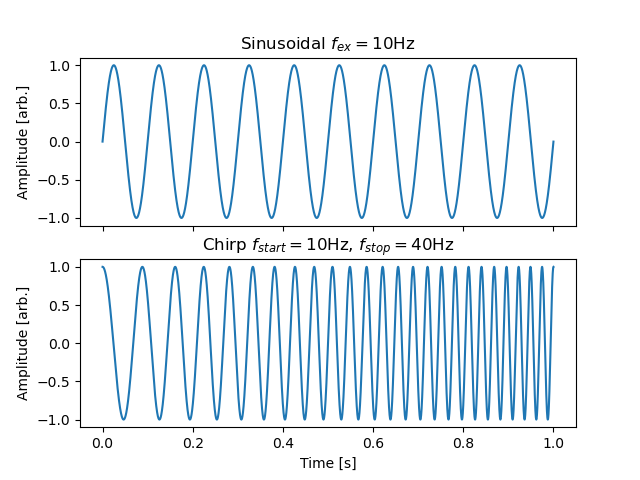
Element
To then define an Exciter element with the custom waveform (array of samples at sampling frequency sampling freq) and normal and skew components KNL and KSL:
# Create beam element
exciter = xt.Exciter(_context = ctx,
    samples = samples,
    sampling_frequency = sampling_freq,
    duration = None,  # defaults to waveform duration
    frev = f_rev,
    start_turn = 0,  # default, seconds
    knl = KNL,
    ksl = KSL,
)

# Add it to the line for tracking as usual
line.insert_element(
    element = exciter,
    name = 'RF_KO_EXCITER',
    index = 42,
)
The optional parameter duration (seconds) may be used to repeat (or truncate) the excitation waveform. It defaults to len(samples)/sampling_freq, the duration of samples.
The element also provides the read-only parameter order, the multipole order, equal to the order of the largest non-zero multipole component knl or ksl.